
Parasites and Diseases
Contagious Ecthyma
A Field Guide
TO COMMON WILDLIFE DISEASES
AND PARASITES IN ALASKA
CONTAGIOUS ECTHYMA, ORF, "sore mouth"
| Description |
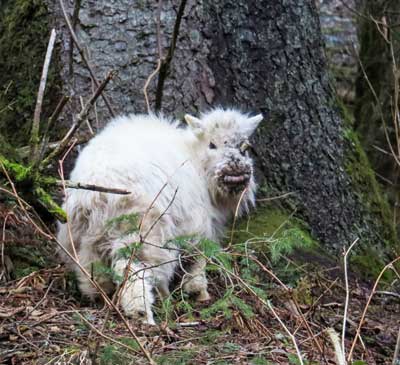
Contagious ecthyma is a skin disease seen around lips, nose, eyes, ears, udder, hooves, and anus of sheep and goats caused by a parapox virus.
| Where does it occur in Alaska? |
Mountain goat kids and Dall's sheep lambs are the most severely affected. The disease also occurs in muskox and reindeer. Mild lesions have also been found in caribou and Sitka black-tailed deer. Moose are susceptible but no cases have been detected in Alaska.
| What are the observable signs? |
It starts as small blisters, then ulcers, and progresses to 'cauliflower-like' proliferations of skin with crusts and scabs. These lesions may exude blood and pus. In kids and lambs it can become so severe they cannot eat or see, and may die. Milder lesions in adults can heal. It is transmitted by direct contact with the lesions or the crusts/scabs into broken skin, mouth, eyes or nose. The crusts remain infective in the environment for up to 12 years.
| Safety – risk to humans, pets, and edibility |
The meat from a harvested healthy animal with only mild lesions is edible. Contact with the crusts or lesions to broken skin or the face can transmit the virus to people. Painful ulcers occur where the virus entered. Although there is no treatment, sores heal in healthy individuals. Rare cases in dogs and cats have been reported so dispose of diseased animal parts and do not feed to pets.
| Prevention |
It is advisable to wear gloves when skinning and butchering. Wash knives in hot, soapy water after skinning and trimming away any diseased tissue, and before using them on clean meat.
| How to report/sample |
Report observations in live, dead, or harvested wildlife to the local or regional ADF&G office, or online at the Parasites and Diseases page on the ADF&G Website.
Photos can be emailed to dfg.dwc.vet@alaska.gov.
| For more information |